I will admit that, while living in Steubenville a few years ago, I experienced a bout of jealousy over the fact that so many of my friends shared names with prominent Catholic Saints, whereas the name Gerald did not appear to stand out in this regard. This led me to do some research to see if there were, in fact, Catholic Saints named Gerald. My search proved more fruitful than I imagined, as I found at least four St. Geralds among the Church Triumphant (not counting those that also went by the alternate spelling Gerard). There was St. Gerald of Mayo, noted as a holy abbot of one of the prominent Irish monasteries of the late 7th and early 8th centuries. There was St. Gerald of Braga, the Portuguese Bishop who died in 1109 and was known for being a vocal opponent of lay investiture (the process of lay nobility appointing hand-picked candidates to ecclessial posts). And there was St. Gerald of Sauve-Majeure, a noted 11th century Benedictine monk and reformer.
There was, however, one particular St. Gerald that caught my attention, and to whom I eventually developed a devotion. As I was remiss in failing to note his feast day this past Tuesday (October 13), I would like to make mention of him now. St. Gerald of Aurillac was a French nobleman who lived during the 10th century. He is unusual among the Saints of his day in many respects, most notably in the fact that he was a layman and lived an ascetic and pious life during a period of history specially noted for the immoral excesses of its nobility. The following biographical sketch, found here, briefly describes the Saint's life and notable accomplishments.
Gerald of Aurillac, Confessor
Born 855 at Saint-Cirgues; died 909. He was of noble birth and suffered lengthy illness in his youth. For this reason, he gave much time to meditation, study, and prayer instead of the martial pursuits that ordinarily would have been expected.
When he succeeded his father as count of Aurillac in Auvergne, and owner of considerable estates, he continued his life of devotion and became noted for his piety and generosity to the poor. He was distinguished for the justice and efficiency with which he discharged the duties of a wealthy nobleman.
His personal life was no less virtuous, and markedly well-ordered and religious. He dressed modestly, ate little, rose every morning at 2:00 a.m.--even when travelling--to say the first part of the Divine Office, and then he assisted at Mass.
But it is possible that he would not have become well-known had he not founded the monastery at Aurillac. After a pilgrimage to Rome, he built a church under the invocation of Saint Peter, and, c. 890, a Benedictine abbey at Aurillac, which was to become famous when it was taken over by the Cluniac order.
He led a life of great goodness for someone of his rank during this rather immoral period in history. He considered becoming a monk at his monastery but was persuaded against it by Gausbert, the bishop of Cahors, who counseled that he would be more useful acting as a layman who devoted himself to his neighbors and dependents. He gave a great part of his revenue to the poor and endowed the monastery generously.
He was blind for the last seven years of his life. He died at Cezenac, Quercy, and was buried at his abbey. He is the patron saint of Upper Auvergne.
Saint Odo of Cluny wrote a Life of Saint Gerald that made him celebrated in medieval France. A later member of Saint Gerald of Aurillac's family was Saint Robert of Chaise-Dieu (d. 1087; canonized c. 1095) who founded the great abbey of that name in Auvergne (Attwater, Encyclopedia, Sitwell, White).
For more information about St. Gerald of Aurillac, you can visit the following links:
- The Life of St. Gerald of Aurillac - by St. Odo of Cluny, a 10th century monk whose research into the life of St. Gerald provides us with most of our extant knowledge of the Saint. This link is to a preview, so some pages are missing, but still a lot of good information.
- Entry on St. Gerald from Butler's Lives of the Saints
- Wikipedia article
As a single man still discerning his vocation and someone who has for the past seven years struggled with recurring and occasionally debilitating bouts of sciatica, I am especially attracted to St. Gerald of Aurillac as an intercessor because he has been proclaimed the patron of bachelors and the disabled. He remains a wonderful model of holiness for laity, for men that are either called to live chaste single life or still discerning a vocation, for those who struggle with disabilities (or any other obstacles that stand in the way of the fulfillment of God's will in our lives) and for those who struggle with a tendency towards materialism. For those seeking a saintly devotion, and even for those are not, I recommend this holy Frenchman as an intercessor. St. Gerald of Aurillac, pray for us! God bless!
In Jesus and Mary,
Gerald
Showing posts with label Saints. Show all posts
Showing posts with label Saints. Show all posts
Thursday, October 15, 2009


Sunday, October 4, 2009
Happy Feast Of St. Francis And Respect Life Sunday!
It is a happy yet fitting coincidence that the two should fall on the same day this year. St. Francis is widely and properly regarded as one of the greatest lovers of life (and especially of the Author of Life) that the Church has ever produced.
Let us remember St. Francis as a lover of life, but also as someone who recognized the pre-eminent value of human life above that of all other material creatures. Let us also remember that he had above all else a deep and abiding love for God and His Church, and dedicated every waking moment of every day to furthering the truths espoused by both. It is one of the great tragedies of modern times that a city named after him by well meaning Spanish missionaries has become a hotbed of hostility towards that which St. Francis loved most. Let us then, on this day, pray for that city, and for all others who set themselves against the truth, that they may experience a true conversion of heart and stand up for the inviolability of human life; and that they may devote their lives to serving the One who created all life and gave that life meaning. God bless!
In Jesus and Mary,
Gerald
Sunday, June 22, 2008
Happy Feast of St. Thomas!
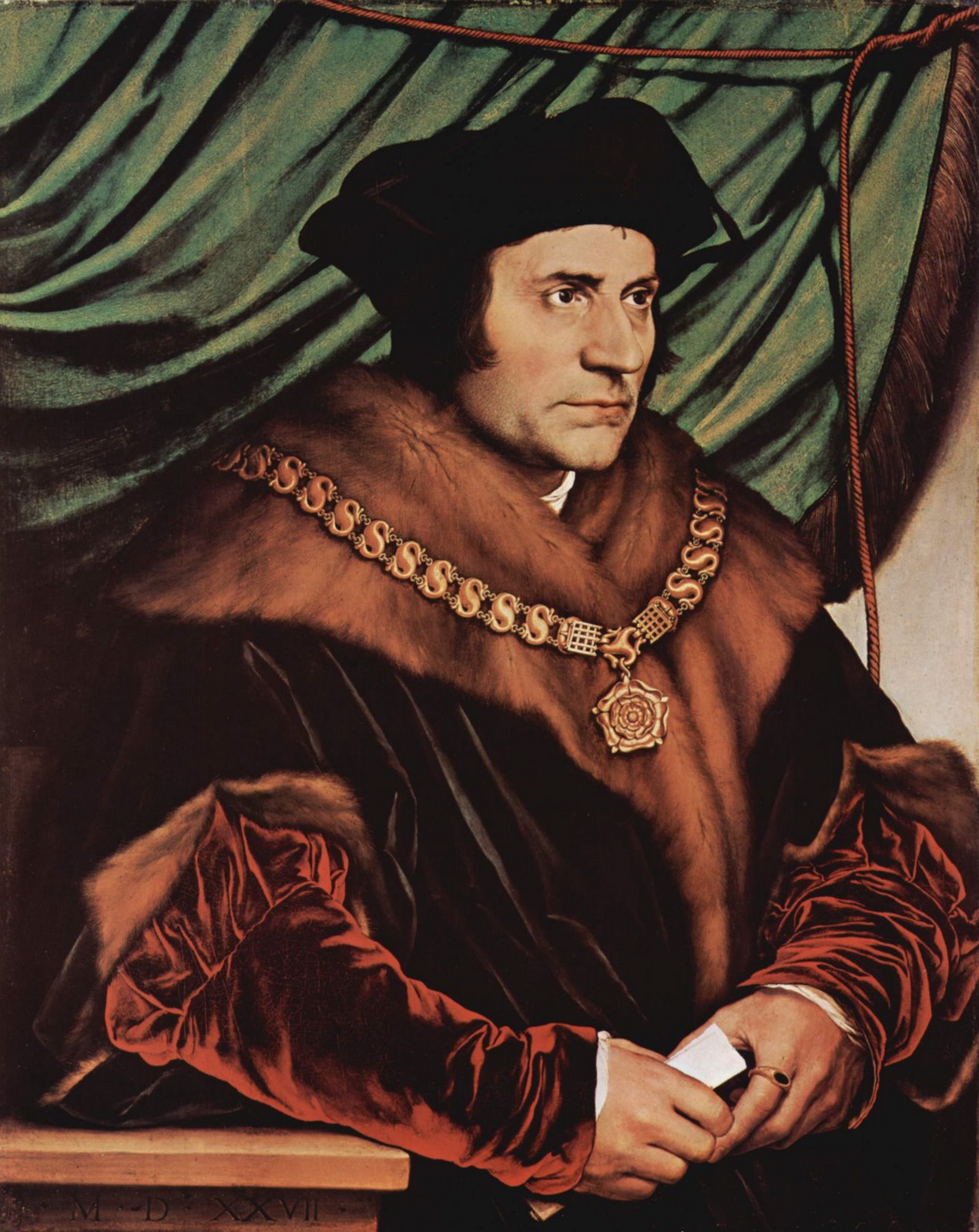
I just realized I neglected to post on this, but since I recently decided to take on St. Thomas More as the patron of this blog, it would be really poor form on my part to neglect to wish each of you a happy feast of St. Thomas More (and of his contemporary, St. John Fisher). SS Thomas and John, ora pro nobis!
Saturday, June 21, 2008
St. Francis of Assisi in Film
A few months ago, I purchased on DVD the 1989 movie Francesco, starring Mickey Rourke as St. Francis of Assisi and Helena Bonham Carter as St. Clare. Despite this, I didn't see the movie for the first time until tonight. Although Rourke especially seemed an odd fit to me in the role of St. Francis (I still have difficulty shaking my image of him as the star of such sexually explicit films as Wild Orchid and 9 1/2 Weeks, to say nothing of his little foray into professional boxing), I was always interested in knowing how this movie compared to the better-known depiction of St. Francis in Franco Zefirelli's 1972 film Brother Sun, Sister Moon. The following few paragraphs contain some spoilers; but if anyone reading this is relying on film depictions to educate themselves on the life of St. Francis, then I daresay that my spoiling the ending for you should be the very least of your concerns. At any rate, this will be short, because it's getting late and I don't want to sleepwalk through Mass tomorrow morning.
The two movies are drastically different, as each has a particular focus. Brother Sun, Sister Moon is what you might expect of a film from the early 70s period, focusing mainly on St. Francis' social justice work and sounding like a "Flower Power" rendition of the saint's life. It isn't necessarily unfaithful to the person of St. Francis (though lines such as "Brother Sun has illuminated me!" occasionally make St. Francis sound more like he's on a New Age inspired acid trip than he is experiencing a radical call to imitate the life of Christ), but the movie certainly does gloss over many aspects of the saint's life, most notably the aspect of physical suffering and the emotional tribulations that St. Francis endures during the course of his life and ministry. There are a few scenes here and there to remind us that St. Francis is Catholic (such as a scene where he gives his blessing to a follower who wishes to leave because he can't handle a life of celibacy, while exhorting the man to be fruitful and multiply, "but with a wife"), but for the most part, those who know nothing about St. Francis going in are left to assume that - were he alive at the time of filming - he would have been wearing a "Hell no, we won't go!" T-shirt and blowing kisses to warriors and pacifists alike. There is one scene towards the end were the viewer is treated to a show of humility from Pope Innocent III - played by the incomparable Sir Alec Guiness - as he formally approves of St. Francis' order. No mention is made of St. Francis' stigmata, which is just as well because I would spare the world images of St. Francis frolicking through a field of flowers and singing 60s folk songs while bleeding from his hands and feet.
Francesco, on the other hand, focuses much more on the tribulations of St. Francis. I found there were a number of unsuitable scenes for a PG-13 movie - including a scene where one of St. Francis' followers runs naked into a Church during Mass and another where St. Francis flings himself naked into a snow bank and we are given some frontal glimpses of Rourke that even viewers of his more "erotic" movies were spared - but for the most part the movie does strike a better balance than Brother Sun, Sister Moon between St. Francis' radical love for God and his fellow man and his immense suffering stemming from a variety of sources. The beginning of the movie does not really go into detail about what prompts St. Francis onto the path of sanctification, but does show moments where Francis is dissatisfied with his life of luxury and is obviously restless in his desire for something more fulfilling. The viewer is expected to know that this longing is for God, as Francis rather abruptly renounces his life as a noble and begins a life of austerity, going door to door begging for food and suddenly embracing the lepers that he had violently been chasing off five minutes before.
What makes Francesco a more faithful rendition of the life of St. Francis, though, is that the portrayal of the saint is much more humanizing. We see his radical selflessness, his desire to embrace the (literal) Cross, and his challenge to his contemporaries to live a less materialistic life; but 60s relics who fondly recall their "make love, not war" days may be disappointed to find that St. Francis is here portrayed not as a model of civil disobedience, but rather as unambiguously Catholic and devoted to a life of austerity devoid of the romantic idealism that runs rampant in Brother Sun, Sister Moon. Francesco is not a man who lives from one magical moment to the next; rather, he is a man who has to deal with the practical realities of sexual temptation (hence the scene where he flings himself into the snow), the consequences of his followers taking his words too literally (hence the need to come to the rescue of the poor young man who suddenly finds himself standing naked in the sanctuary of a cathedral during Mass), and the antagonism of those who are drawn to his order by his idealism but who are unwilling to abide by his requirement that they imitate his life of austerity and radical poverty. Thankfully, the stigmata is also not portrayed as some wonderful mark of holiness to be marveled at by others for the benefit of the bearer, but rather as a sign that the saint's call to love as Jesus loved was genuine and that, as St. Clare puts it, his love for Christ had caused his body to bear the marks of his Beloved. The wounds of Christ are the culmination of St. Francis' mission on earth (again, in imitation of his Beloved), for he dies shortly thereafter.
There is much more that can be said here; but as I mentioned before, my time for the night is short. If I have to recommend one movie over the other, I would pick Francesco, though not without caution. Of course, I recommend it only as a way to help bring the saint to life for the visually oriented, for we should be looking to other sources to educate ourselves (I would most especially recommend G.K. Chesterton's "St. Francis of Assisi;" and if that surprises you, I have some waterfront property in New Orleans overlooking some nice levees that I'd like to sell you :-). That is all for tonight. I pray all's well. God bless!
In Jesus and Mary,
Gerald
Thursday, June 19, 2008
On St. Isidore of Seville
A great meditation from our Holy Father on the contributions of St. Isidore of Seville, one of the 33 Doctors of the Church.
The address is reprinted in its entirety below. The original article can be found here.
The address is reprinted in its entirety below. The original article can be found here.
Dear Brothers and Sisters,
Today I wish to speak of St. Isidore of Seville, younger brother of Leander, bishop of Seville, and great friend of Pope Gregory the Great. This relation is important because it leads us to keep in mind a cultural and spiritual approach that is indispensable to understanding Isidore's personality. In fact, he owed much to Leander, a very exacting, studious and austere person, who had created around his younger brother a family context characterized by ascetic demands proper of a monk and the rhythms of work required by serious dedication to study.
In addition, Leander was attentive to prepare in advance what was necessary to address the political-social situation of the moment: In those decades, in fact, the Visigoths, barbarians and Arians, had invaded the Iberian Peninsula and taken over territories belonging to the Roman empire. It was necessary to win them over to Romanism and Catholicism. Leander and Isidore's home had quite a rich library of classical, pagan and Christian works. Isidore, who felt attracted simultaneously to both one and the other, was taught, therefore, to develop, under the watchfulness of his elder brother, a very strong discipline in dedicating himself to their study with discretion and discernment.
In the bishop's residence in Seville one lived, therefore, in a serene and open climate. We can deduce this from Isidore's cultural and spiritual interests, as they emerge from his works themselves, which contain an encyclopedic knowledge of the pagan classical culture and in-depth knowledge of Christian culture. Thus can be explained the eclecticism that characterizes Isidore's literary output, which extends with great ease from Marcial to Augustine, and from Cicero to Gregory the Great.
Indeed, the interior struggle that the young Isidore had to endure, having become his brother Leander's successor in the episcopal chair of Seville in 599, was not light. Perhaps the impression of excessive voluntarism that one detects when reading the works of this great author -- regarded as the last of the Christian fathers of antiquity -- is due precisely to this constant struggle with himself. A few years after his death, which occurred in 636, the Council of Toledo of 653 described him as: "Illustrious teacher of our time and glory of the Catholic Church."
Isidore was without a doubt a man of accentuated dialectical oppositions. And, also in his personal life, he experienced a permanent interior conflict, rather like that which St. Gregory the Great and St. Augustine had already noted, between the desire for solitude, to dedicate themselves solely to meditation on the word of God, and the exigencies of charity toward his neighbors, for whose salvation, as bishop, he felt responsible.
He wrote, for example, in connection with persons responsible for the Churches: "The person responsible for a Church -- "vir ecclesiasticus" -- must on one hand allow himself to be crucified to the world with the mortification of the flesh and, on the other, accept the decision of the ecclesiastical order, when it stems from the will of God, to dedicate himself to governance with humility, even if he does not wish to do it" (Sententiarum liber III, 33, 1: PL 83, col 705 B).
He then adds just another paragraph: "The men of God -- "sancti viri" -- do not in fact desire to dedicate themselves to worldly things and lament when, by a mysterious plan of God, they are entrusted with certain responsibilities. They do anything to avoid it, but accept that which they wish to flee, and do that which they would have wished to avoid. In fact, they enter into the secret of the heart and therein try to understand what the mysterious will of God requests. And when they realize that they must submit to God's plans, they humble their hearts under the yoke of the divine decision" (Sementarium liber III, 33, 3: PL 83, coll. 705-706).
To better understand Isidore, we must recall, first of all, the complexity of the political situations of his time, to which I have already made reference: During the years of his childhood he had experienced the bitterness of exile. Despite this, he was permeated with apostolic enthusiasm: He experienced the rapture of contributing to the formation of a people who were finally rediscovering their unity, whether on the political or the religious plane, with the providential conversion of Erminigild, the heir to the Visigothic throne, from Arianism to the Catholic faith.
However, we must not underestimate the enormous difficulties he faced in adequately addressing very grave problems such as those of relations with the heretics and the Jews -- a whole series of problems that appear very concretely also today, above all, if we consider what happens in certain regions in which it seems that situations somewhat similar to those of the Iberian Peninsula of the 6th century have reappeared. The wealth of cultural knowledge that Isidore possessed allowed him to constantly confront the Christian novelty with the Greco-Roman classical heritage, even if, beyond the precious gift of synthesis, it seems he also had that of "collatio," namely, of compilation, which was expressed in an extraordinary personal erudition, not always ordered as might have been desired.
To be admired, in any case, is his persistent desire not to neglect anything of that which human experience had produced in the history of his homeland and of the whole world. Isidore did not wish to lose anything that was acquired by man in ancient times, whether pagan, Jewish or Christian. We should not be surprised, therefore, if, in pursuing this purpose, at times he was not successful in passing on adequately, as he would have wished, the knowledge he possessed through the purifying waters of the Christian faith.
In fact, however, in Isidore's intentions, the proposals he makes are always in harmony with the Catholic faith, which he firmly upheld. In the discussion of several theological problems, he shows perception of their complexity and often suggests with acuity solutions that take up and express the complete Christian truth. This enabled believers through the course of the centuries and up to our times to benefit with gratitude from his definitions. A significant example of this matter is offered to us by Isidore's teaching on the relationships between the active and contemplative life.
He writes: "Those who seek to attain the repose of contemplation must first train themselves in the stage of the active life; and thus, freed from the dross of sins, will be able to exhibit that pure heart which, alone, allows one to see God" (Differentiarum Lib II, 34, 133: PL 83, col 91A).
The realism of a true pastor convinces him however of the risk that the faithful run of reducing themselves to being one-dimensional men. Hence, he adds: "The middle way, composed of both ways of life, is generally more useful to resolve those tensions that often are acute by the choice of only one kind of life and are better tempered by an alternation of the two ways" (o.c., 134: ivi, col 91B).
Isidore looks for the definitive confirmation of a correct orientation of life in the example of Christ and says: "Jesus the Savior offers us the example of the active life when, during the day he dedicated himself to offer signs and miracles in the city, but he showed the contemplative life when he withdrew to the mountain at night and dedicated himself to prayer" (o.c. 134: ivi).
In the light of the example of the divine Teacher, Isidore could conclude with this precise moral teaching: "Therefore, the servant of God, imitating Christ, must dedicate himself to contemplation without denying himself the active life. To behave otherwise would not be right. In fact, as we must love God with contemplation, so we must love our neighbor with action. It is impossible, therefore, to live without the presence of one and the other way of life, nor is it possible to love if one has no experience of one or the other" (o.c., 135: ivi, col 91C).
I hold that this is the synthesis of a life that seeks the contemplation of God, dialogue with God in prayer and the reading of sacred Scripture, as well as action in the service of the human community and of one's neighbor. This synthesis is the lesson that the great bishop of Seville leaves us, Christians of today, called to witness to Christ at the beginning of a new millennium.
[Translation by ZENIT]
[The Pope then greeted pilgrims in several languages. In English, he said:]
Dear Brothers and Sisters,
In today's catechesis we turn to Saint Isidore of Seville, the brother of Saint Leander and a contemporary and friend of Saint Gregory the Great. Isidore lived during the Visigothic invasions of Spain, and he devoted much energy to converting the barbarian tribes from heresy and preserving the best fruits of classical and Christian culture. His encyclopedic, albeit somewhat eclectic, learning is reflected in his many writings, including the Etymologies, which were widely read throughout the Middle Ages. Isidore worked to bring the richness of pagan, Jewish and Christian learning to the rapidly changing political, social and religious situations in which he lived. Throughout his life, he was torn between his devotion to study and contemplation, and the demands made by his responsibilities as a Bishop, especially towards the poor and those in need. He found his model in Christ, who joined both the active and contemplative life, and sought to "love God in contemplation and one's neighbor in action" (Differentiarum Liber, 135). This is a lesson which is as valid today as it was in the life of the great Bishop of Seville.
I am pleased to welcome the Missionary Sisters of Our Lady of Apostles gathered in Rome for their General Chapter, and the participants in the Rome Seminar of the Association of Catholic Colleges and Universities. I also warmly greet a group of survivors of the Holocaust who are present at today's Audience. Upon all the English-speaking pilgrims, especially those from England, South Africa, Australia, Vietnam and the United States, I cordially invoke God's blessings of joy and peace.
© Copyright 2008 - Libreria Editrice Vaticana
Subscribe to:
Posts (Atom)